What eBay Sold Data Costs in 2026: Subscription vs Pay As You Go
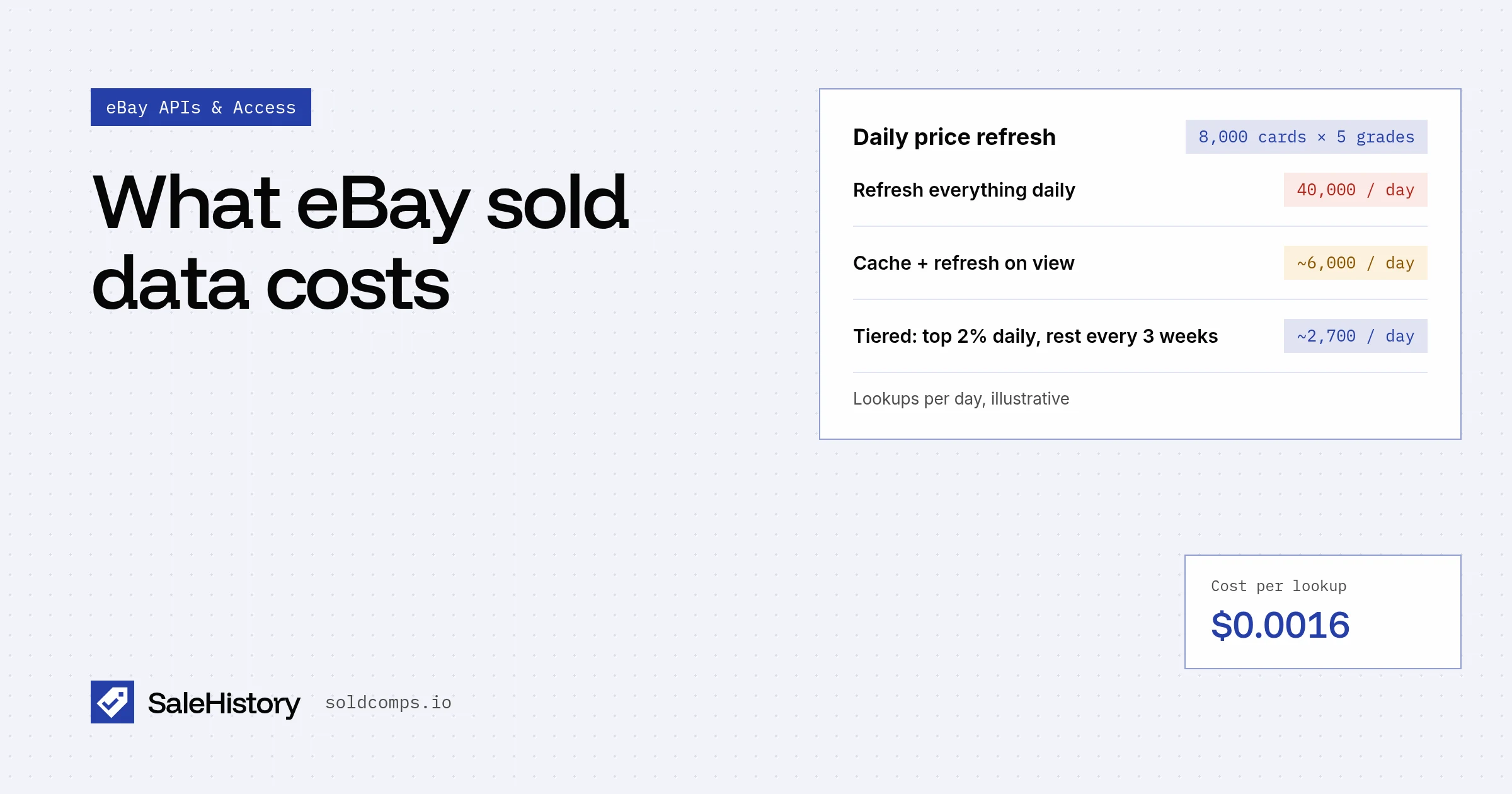
"How much does eBay sold data cost?" sounds like it should have one answer. It doesn't, because in 2026 there are three ways to get it, and they cost very different things: access you can't get, engineering time, or a per-request fee.
Here's what each route really costs, then the math for choosing between a subscription and pay as you go.
Option 1: eBay's official route
eBay used to give developers sold data for free. That's mostly over:
- Finding API,
findCompletedItems: shut down in February 2025. Code that relied on it gets nothing back. What replaced it. - Marketplace Insights API: the official sold-data API, but it's limited release and closed to new users.
So the price of the official route is zero, but for most new projects it isn't available at any price. Longer answer in does eBay have a sold listings API.
Option 2: build your own scraper
The scraper looks free until you add it up:
- Proxies. eBay blocks repeated requests from the same IPs, so you pay for rotating residential proxies.
- Maintenance. Page markup changes, and every change is a silent bug in your price data.
- The sign-in wall. Since 2026, eBay requires signing in to see sold listings. Logged-out scrapers that worked for years now return empty pages, which is why so many people hit empty results from their eBay sold scraper.
The real cost is developer hours, and it's recurring.
Option 3: a hosted sold comps API, priced per request
A hosted API does the fetching, sign-in, parsing and cleanup, and you pay per request. The detail that matters most is what counts as a request.
Pay per search, not per result
With a sold comps API priced per search, one request is one search, and one search returns up to 200 sold listings. Pricing per result would bill those 200 listings as 200 units. For comps you almost always want the whole set (median, 25th and 75th percentile, auction vs Buy It Now), so per-search pricing is what keeps the cost predictable:
curl "https://api.soldcomps.io/v1/sold?q=rtx+3080&condition=used" \
  -H "Authorization: Bearer $SALEHISTORY_KEY"
# → { "count": 161, "stats": { "median": 432.00, "p25": 394.00, "p75": 515.00, ... } }
That's 161 used RTX 3080 sales (eBay US sold listings, last 90 days, pulled Oct 23, 2026; prices move) for the price of one request.
Subscription vs pay as you go
These are our sold comps API pricing options:
- Pay as you go: $2.50 per 1,000 requests, from $5. Repeat searches within 12 hours, searches with no sales and failed requests are free. Credits never expire.
- Starter: $5/month for 1,250 requests.
- Growth: $29/month for 12,000 requests.
- Scale: $79/month for 60,000 requests.
Plans that run out draw from pay-as-you-go credits, so you can combine a plan with credits. Here's the cheapest option at each monthly volume:
| Monthly searches | Pay as you go | Best plan option | Cheapest |
|---|---|---|---|
| 500 | $1.25 | Starter $5 | Pay as you go (a $5 top-up lasts about 4 months) |
| 2,500 | $6.25 | Starter + 1,250 credits $8.13 | Pay as you go, $6.25 |
| 5,000 | $12.50 | Starter + 3,750 credits $14.38; Growth $29 | Pay as you go, $12.50 |
| 12,000 | $30.00 | Growth $29 | Growth, $29 |
| 30,000 | $75.00 | Growth + 18,000 credits $74; Scale $79 | Growth + credits, $74 (near tie) |
| 60,000 | $150.00 | Scale $79 | Scale, $79 |
The break-even points:
- Growth beats pay as you go at 11,600 searches a month ($29 ÷ $2.50 per 1,000).
- Scale beats Growth plus credits at 32,000 searches a month ($29 + 20,000 credits = $79).
- Starter is a budget, not a discount. Per request it costs more than pay as you go; it suits teams that want one fixed monthly bill instead of topping up credits. The per-request savings start at Growth.
Rule of thumb
- Spiky or seasonal usage → pay as you go. A reseller tool that's busy in Q4 and quiet in February shouldn't pay for unused quota. Credits never expire, so a slow month costs nothing.
- Steady high volume → a plan. If you reliably run 12,000+ searches every month, Growth or Scale is cheaper per search.
- Cache-friendly workloads → pay as you go goes further. Repeats of the same search within 12 hours are free. If your users keep looking up the same popular items, many of those requests cost nothing.
How to estimate your volume
Volume is items × versions × refreshes per month. Count each version (each grade, condition or variant) as its own search, because each one is.
Example: a card app tracking 8,000 cards in 4 grades has 32,000 searches per full refresh. Refreshed weekly, that's 32,000 × 4.3 ≈ 137,600 searches a month. On Scale plus credits that's $79 + 77,600 credits ($194) = $273 a month; pure pay as you go is $344.
At that size, two things help more than plan choice:
- Refresh only what moves. Popular cards and recent movers weekly or daily, the long tail monthly or when a user views it.
- Talk to us. Volumes past the Scale plan are worth a conversation.
Strategies that cut lookups by 85 to 95% are in how to price thousands of items without refreshing everything.
Try before you estimate
The free plan includes 100 requests a month, no card needed. Run a handful of your real queries through the sold comps lookup, check that the sold comps come back clean, then size your volume. When you're ready, read the docs or create a key.
Frequently asked questions
How much does eBay sold data cost?
eBay doesn't sell it directly to new developers. A hosted sold comps API charges per search: $2.50 per 1,000 requests pay as you go, or plans from $5 a month for 1,250 requests. Each request returns up to 200 sold listings.
Is eBay's own sold data API free?
The Marketplace Insights API is limited release and closed to new users, and the Finding API's findCompletedItems call was shut down in February 2025. So for most developers there is no official option to price.
Should I pick a subscription or pay as you go?
Estimate your monthly searches. Under about 11,600 a month, or with spiky usage, pay as you go is cheaper. Steady volume around 12,000 or more fits a plan, and above about 32,000 a month the largest plan wins.
Do repeat searches cost extra?
No. The same search with the same filters within 12 hours is free, and so are searches that find no sales and failed requests. Caching and repeated lookups make the effective price lower than the list price.