How to Comp Trading Cards With eBay Sold Listings (Raw vs Graded, Parallels, No Comps)
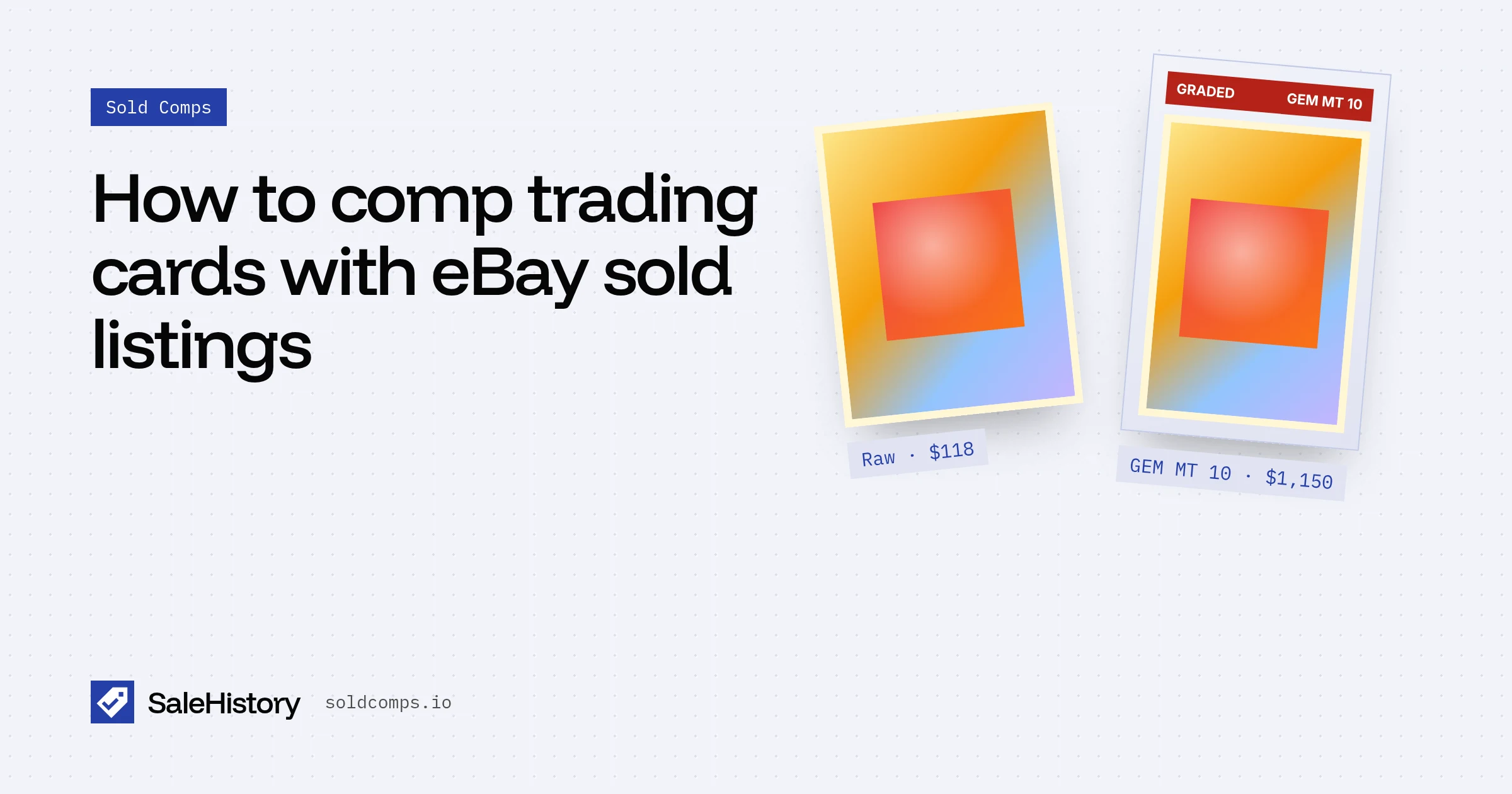
"The hobby is obsessed with comps," as one popular r/sportscards thread put it. And for good reason: the same card can be worth $118 raw and $1,150 in a PSA 10 slab. Get the version wrong and your comp is off by 10x.
The #1 card comp mistake: one median for every version
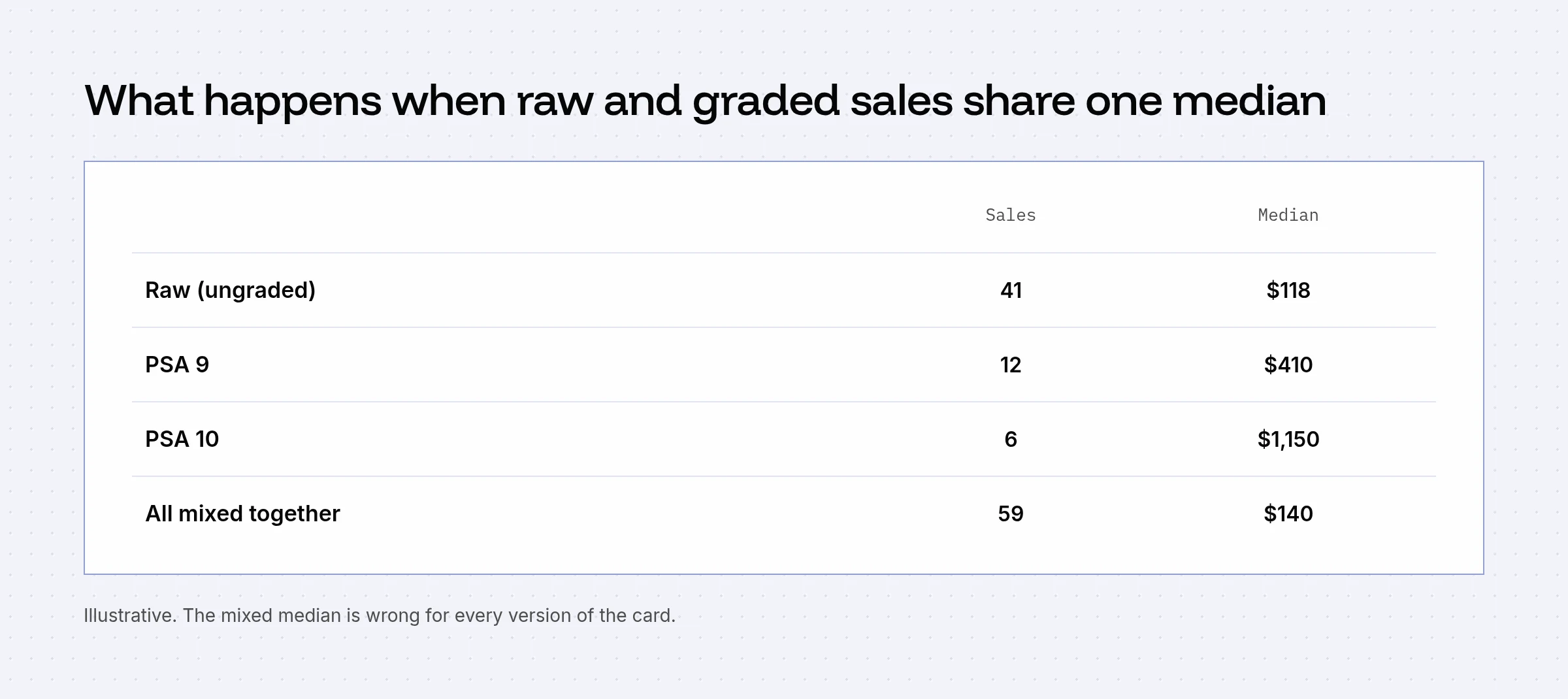
A search for a card name returns raw copies, every grade, every grader, and lots. The "average" of all that describes a card that doesn't exist. Card app developers run into this at scale: one builder tracking 8,000 cards needed "different variations such as Raw, PSA 8 9 10", which turned 8,000 cards into 40,000 separate lookups. That's the right instinct. Every version is its own comp.
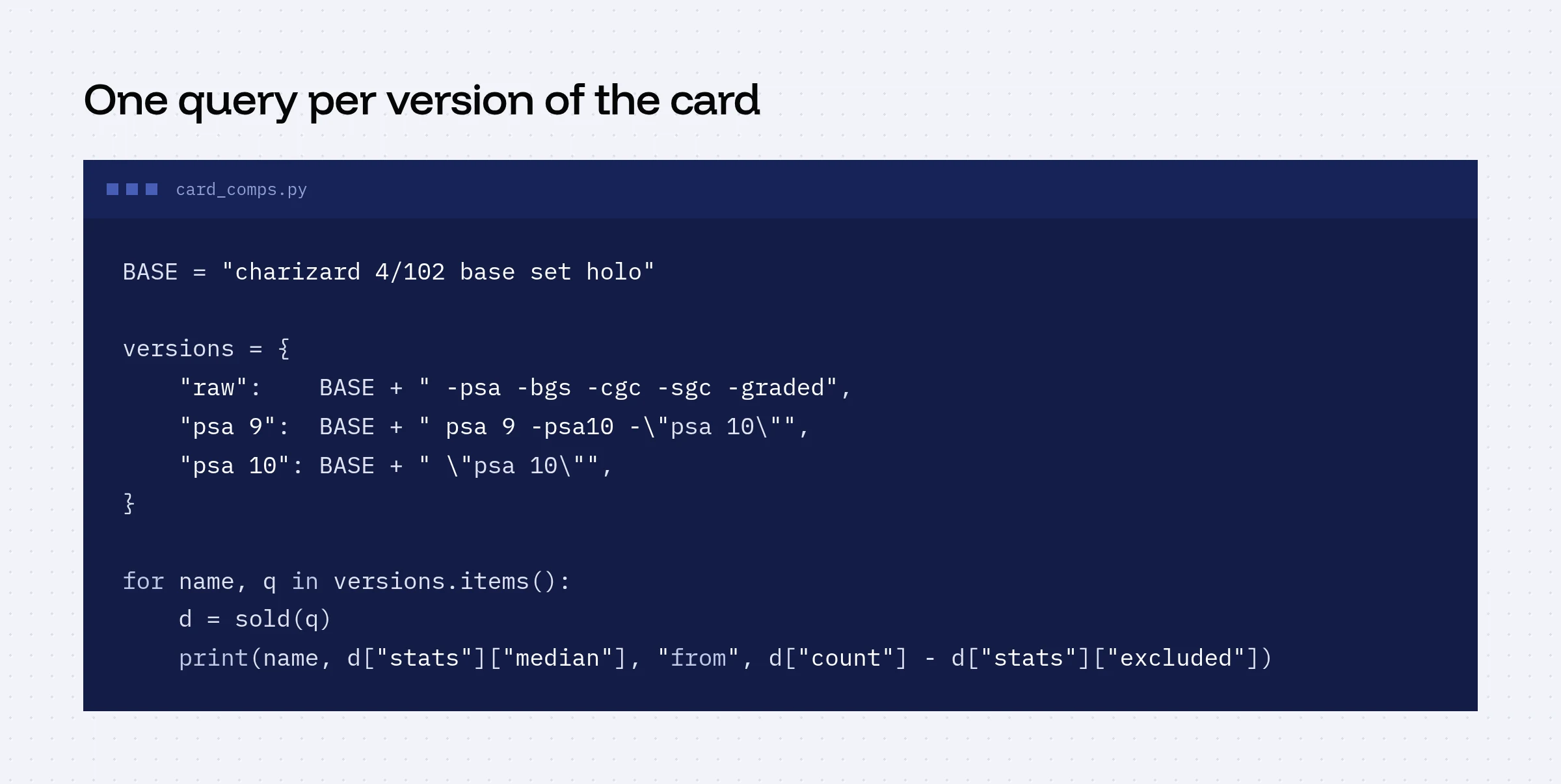
Search each version separately
- Start specific: name + set + card number. "charizard 4/102 base set holo", not "charizard".
- Raw: exclude graded copies with minus words:
-psa -bgs -cgc -sgc -graded -slab. - Graded: include the grader and grade in quotes, and exclude the neighbors:
"psa 9" -"psa 10". - Drop lots and "you pick" listings.
- Take the median, and check the count.
Different graders aren't interchangeable
Collectors' rules of thumb, from recent threads: "BGS is usually valued 1 grade lower when comparing it to PSA," and "BGS only gets a premium for a 10." For a low-pop CGC 10, one experienced seller advised to "expect 10-30% of the PSA 10 price" when selling to a dealer. These vary widely by card. Treat them as starting points, and comp the exact grader and grade whenever sales exist.
Parallels and numbered cards
A /99, a /49 and a 1/1 of the same player are different cards. Include the serial run in the search (/49) and check titles: sellers often write "#/49" or "numbered to 49." If your exact run has no sales, use the comp ladder:
- The next run up and down (/75 and /25 around a /49)
- The same run, adjacent year or set
- The base card's multiple: if base sells for $10 and /99 for $40, a /49 likely sits above $40
When there are no comps at all
"How to price extremely low pop CGC 10 with no comps? … the only comp is mine." It happens constantly with low-pop slabs and new parallels. Options, best first:
- Comp the ladder above and price between neighbors.
- Use a longer window. Product Research in Seller Hub shows older averages.
- Auction it with a sensible start price and let the market set the comp.
Whatever you do, a missing comp should be treated as "no data," not "$0."
Watch the format and the offers
Card auctions often close below Buy It Now sales of the same card (details), and a lot of card sales are accepted Best Offers where eBay hides the real price (details). Split by format, and drop offers with hidden prices.
Building a card app?
The same rules, in code: one query per version, lots excluded, hidden Best Offers left out of the median, and an honest zero when a card has no sales:
curl "https://api.soldcomps.io/v1/sold?q=charizard+4%2F102+%22psa+10%22" \
  -H "Authorization: Bearer $SALEHISTORY_KEY"
If you're pricing thousands of cards, read how to price a big catalog without 40,000 lookups a day.
More for card sellers and builders: Pokémon card prices, baseball card prices for a whole collection, and how card scanner apps get prices.
Frequently asked questions
How do I find sold prices for Pokémon cards on eBay?
Sign in, search the card name with set and number (for example 'charizard 4/102 base set'), tick Sold items, and add the grade if it's graded. Exclude other grades with minus words, and ignore lots.
How do you price a card with no sold comps?
Look at the nearest versions: the next grade up and down, the next print run (for example /75 and /49 for a /50 card), the same grade from a different grader, or the same card from a nearby set. Price between them and expect a wider range.
Is a BGS or CGC 10 worth the same as a PSA 10?
Usually not. Collectors commonly report that other graders' slabs sell below the PSA equivalent of the same grade, but the gap varies a lot by card. Comp the exact grader and grade when sales exist.
Should card comps use the last sale or the median?
The median of recent clean sales. A single last sale can be a no-bid auction, a damaged copy or a cancelled order. Check the date range too, because card prices can move within weeks.
Sources
- r/sportscards: The hobby is obsessed with comps (Aug 2026) (accessed Oct 22, 2026)
- r/PokeInvesting: BGS vs PSA sold prices for the same grade (Oct 2026) (accessed Oct 22, 2026)
- r/CGCCards: How to price an extremely low pop CGC 10 with no comps (Sep 2026) (accessed Oct 22, 2026)
- r/soccercard: Pricing parallels with no comps for your number (Jul 2026) (accessed Oct 22, 2026)
- r/scrapingtheweb: Daily prices for 8,000 cards across Raw, PSA 8, 9, 10 (Aug 2026) (accessed Oct 22, 2026)
SaleHistory sells an eBay sold-listings API, so we have a commercial interest in this topic. We link primary sources so you can check our work. Spotted something out of date? Email hello@soldcomps.io.