eBay Average Sold Price: Why You Should Use the Median Instead
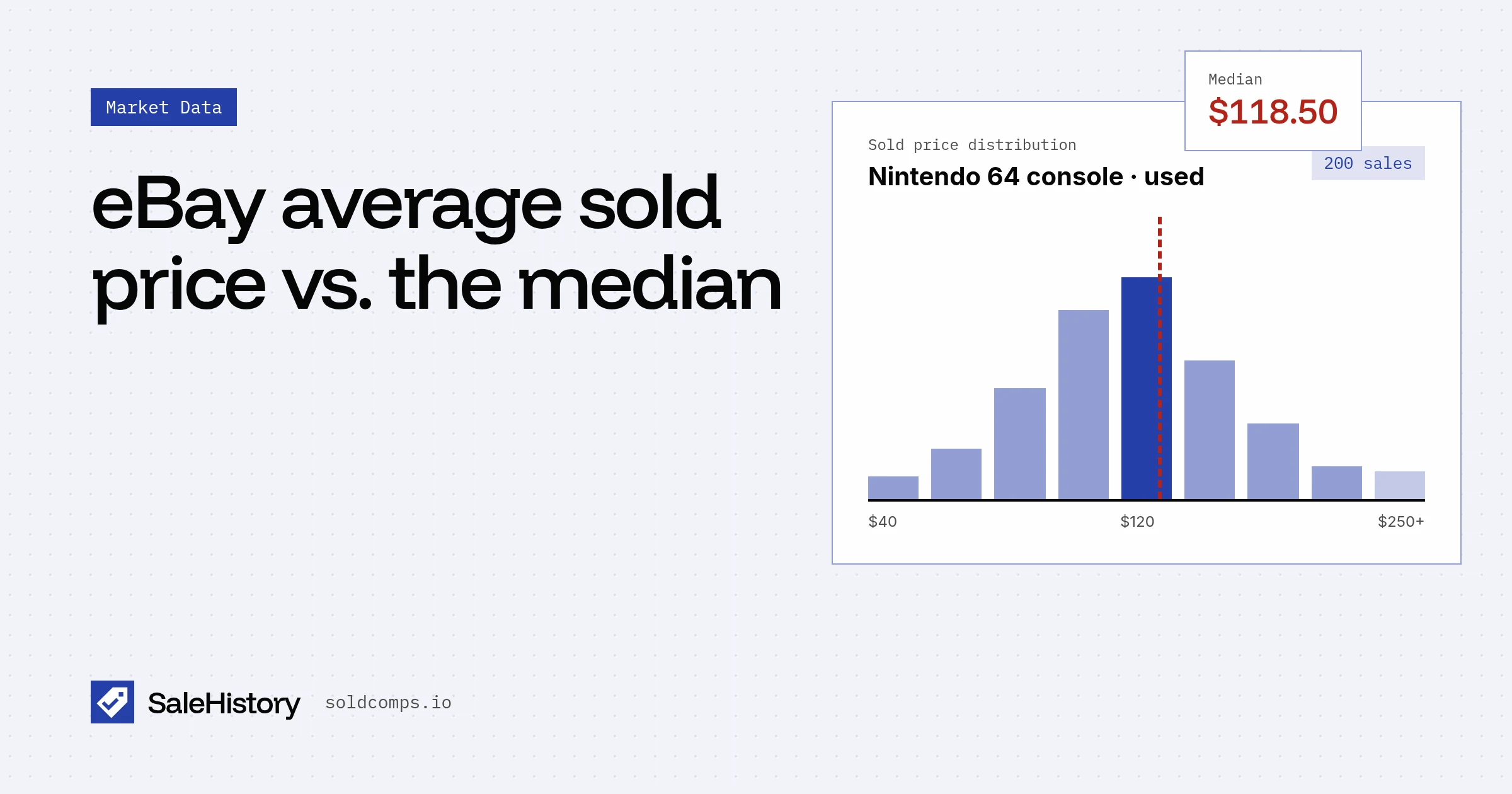
Resellers already do this in their heads. "If there is 1 outlier i scrap that" is the median-minus-outliers rule, done by eye. Here's the version you can put in code.
Why the average lies
eBay sold data has a long right tail. For almost any search you'll find:
- Bundles and lots ("console + 12 games")
- Sealed or graded copies priced like a different product
- Best Offers shown at list price, which inflate the number (details)
- For-parts sales dragging the low end down
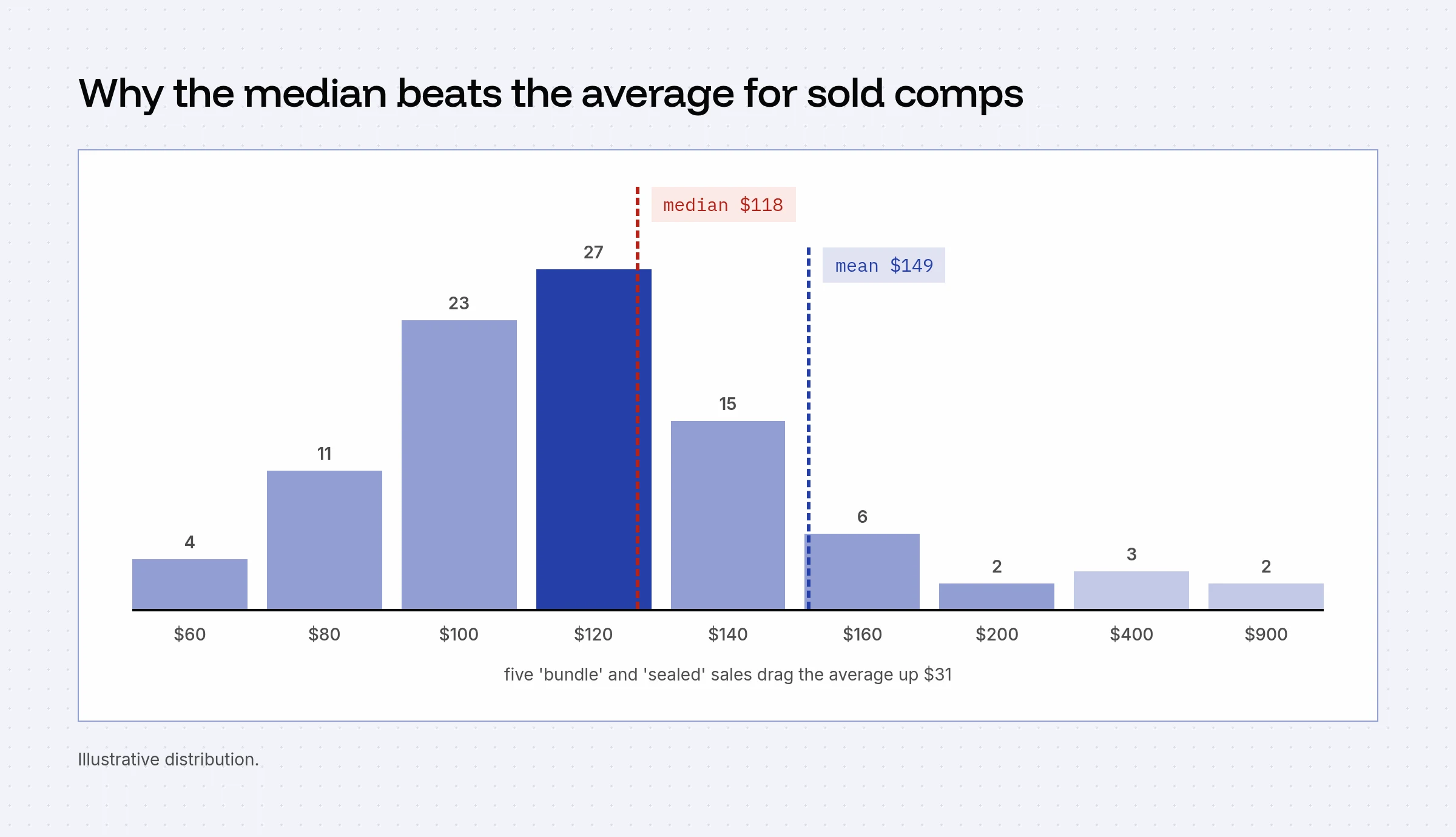
The mean adds everything up, so those few sales move it a lot. The median is just the middle sale, so they barely matter.
The rule we use
- Drop known junk: lots, for-parts, box-only listings, and Best Offers whose real price is hidden.
- Drop statistical outliers with the IQR rule. Q1 is the 25th percentile, Q3 the 75th, IQR = Q3 − Q1. Drop anything below Q1 − 1.5×IQR or above Q3 + 1.5×IQR.
- Take the median of what's left.
- Report the count alongside it. Ten clean sales is a price; three is a hint.
This is exactly what the stats block in a SaleHistory response does. You also get the raw items if you'd rather apply your own rules.
In Python
import statistics

def fair_price(prices):
    s = sorted(prices)
    if len(s) < 4:
        return statistics.median(s) if s else None
    q1, _, q3 = statistics.quantiles(s, n=4)
    iqr = q3 - q1
    kept = [p for p in s if q1 - 1.5 * iqr <= p <= q3 + 1.5 * iqr]
    return statistics.median(kept), len(kept)

prices = [96, 104, 110, 115, 118.5, 121, 124, 130, 139, 145, 389.99, 899]
print(fair_price(prices))   # (119.75, 10)
print(statistics.mean(prices))  # 207.6 — the average is wildly off
In a spreadsheet
If your sold prices are in B2:B50:
Q1:      =QUARTILE(B2:B50, 1)
Q3:      =QUARTILE(B2:B50, 3)
Fair:    =MEDIAN(FILTER(B2:B50, B2:B50>=Q1-1.5*(Q3-Q1), B2:B50<=Q3+1.5*(Q3-Q1)))
Or skip this entirely with our =SOLDMEDIAN() formula.
When the average is fine
If you're estimating total revenue from many items, like a whole estate, the average of clean prices is fine, since the extremes even out across hundreds of sales. For pricing one item, use the median.
Seeing a price that's way off? It may not be a real sale at all: cancelled sales, revised prices and shill bids. And if eBay's own suggestion disagrees with your median, here's why.
Frequently asked questions
Why is the median better than the average for pricing?
The median is the middle sale, so a few extreme prices barely move it. The average adds every price together, so one $900 sealed bundle can pull a $118 item's average up by tens of dollars.
What is the IQR rule for outliers?
Find the 25th percentile (Q1) and 75th percentile (Q3). The interquartile range is Q3 minus Q1. Anything below Q1 minus 1.5 times the IQR, or above Q3 plus 1.5 times the IQR, is treated as an outlier.
How many sales do I need for a reliable median?
At least 10 clean sales is a good rule of thumb. With fewer than 5, report the price as a range rather than a single number.
Sources
- NIST/SEMATECH e-Handbook of Statistical Methods: Measures of location (accessed Oct 22, 2026)
- NIST/SEMATECH e-Handbook: Detection of outliers (accessed Oct 22, 2026)
- r/reselling: Anyone else spending way too long pricing items? (accessed Oct 22, 2026)
SaleHistory sells an eBay sold-listings API, so we have a commercial interest in this topic. We link primary sources so you can check our work. Spotted something out of date? Email hello@soldcomps.io.