How Many Sold Comps Do You Need? A Rule of Thumb for Resellers
You found the item, you pulled up the sold listings, and there are four sales. Is that enough to price it? Sometimes. The honest answer depends on two things: how many sales you have, and how much they disagree with each other.
Here's a practical rule of thumb, plus real eBay data showing why count alone isn't the whole story. Treat it as guidance, not law.
The rule of thumb
Count only clean sales: the same item, the same condition, no lots, no for-parts listings, no boxes sold empty.
| Clean recent sales | What you have | What to do |
|---|---|---|
| 10 or more | A price | Use the median. Check the middle range. |
| 3 to 9 | A rough guide | Price at or a bit under the median. Expect to adjust. |
| Under 3 | A guess | Widen the search, or treat as rare and test with an auction. |
If the sold comps are new to you, start with what sold comps are and how to read them.
Why the count matters
With a handful of sales, a single odd one moves everything. One no-bid auction at $16, one bundle that slipped through, one Best Offer that shows the list price: any of them can drag an average a long way.
The median resists this. It's the middle sale, so one weird number at either end barely touches it. That's why every sold comps tool you should trust reports a median, not an average. The full explanation is in median vs average sold price.
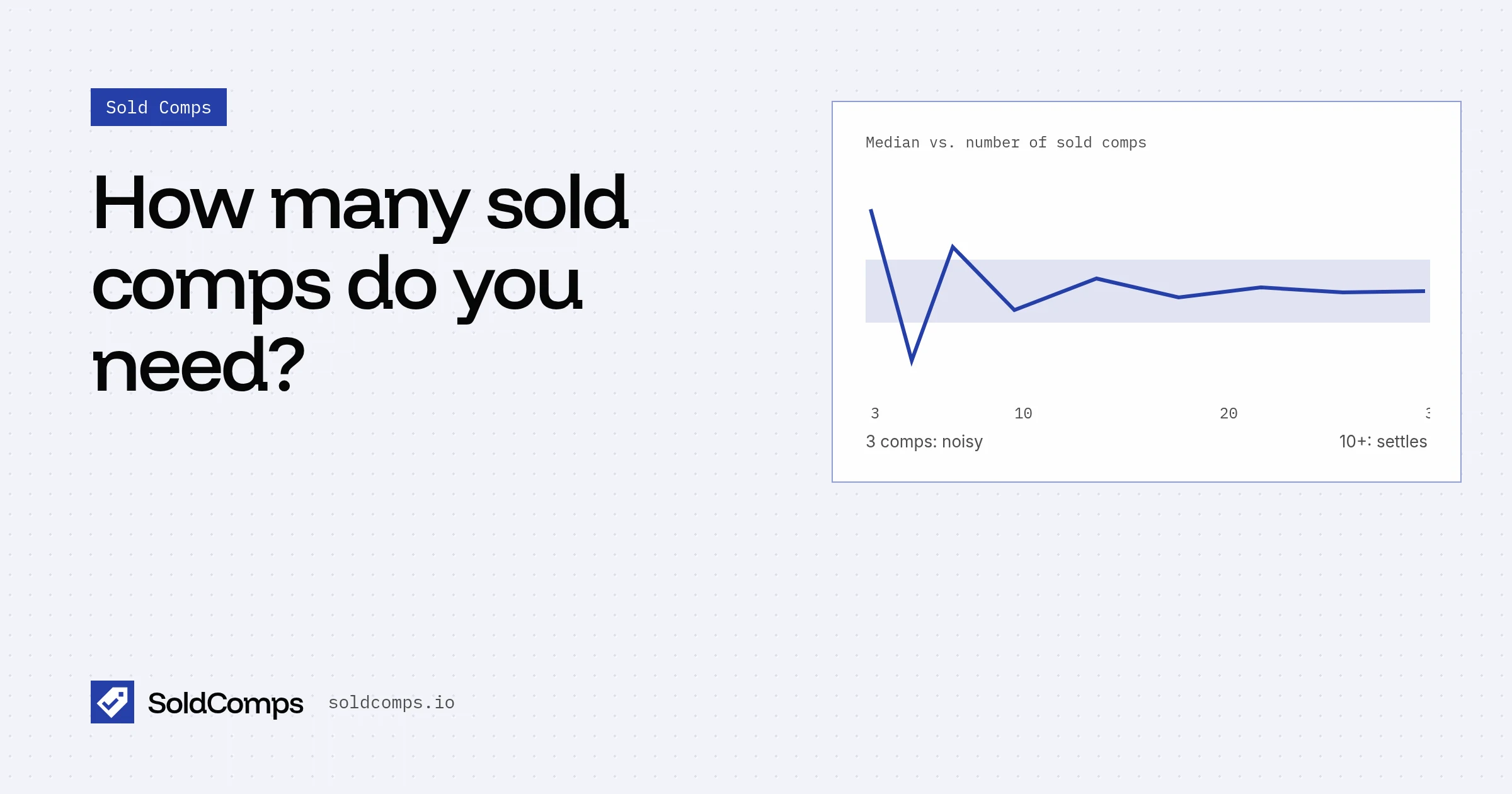
But the median only resists outliers when there are enough normal sales around it. With three sales, the "middle" one is still just one sale. With ten or more, it's a real consensus.
Count and spread work together
The second number to look at is the middle range: the 25th to 75th percentile, where the middle half of sales landed. A tight range means buyers agree on the price. A wide one means they don't, or that your search is mixing different things.
Three examples from eBay US sold listings, last 90 days, pulled Oct 26, 2026 (prices move, so treat these as a snapshot):
| Item | Clean sales | Median | Middle half | What it tells you |
|---|---|---|---|---|
| Pokémon Emerald (GBA, used) | 17 | $110 | ~$86–$180 | Thin and wide: rough guide |
| Nintendo Switch OLED (used) | 147 | $175 | ~$150–$197 | Deep and tight: confident |
| Vintage Singer sewing machine | 131 | $65 | ~$25–$250 | Deep but wide: narrow the search |
Thin and wide: Pokémon Emerald
Seventeen clean sales clears the 10-sale bar, but only just, and the middle half spans almost $100. The full range ran from $16 (the only auction) to $600. Listings for a game like this can mix loose carts, boxed copies and reproductions. A $110 median is useful, but price conservatively and read the individual listings before you commit.
Deep and tight: Switch OLED
147 clean sales (after dropping 42 lots, boxes and parts listings) with a middle half of about $150 to $197. That's a market that agrees with itself. If yours is a standard used console, the median is a price you can list at.
Deep but wide: vintage Singer
131 clean sales sounds like plenty, yet the middle half runs from about $25 to $250. That's not noise. "Vintage Singer" covers dozens of models, from common portables to sought-after machines, plus everything from working to untested. The count is high, but the comps aren't comparable. Add the model number and condition, and the spread should shrink.
The lesson: a high count with a wide spread isn't a price yet. Narrow the search until the middle range tightens.
When you have fewer than 3 sales
Before you decide the item is rare, try widening the search in this order:
- Adjacent variants. A different color, a near-identical model number, the same item without the box. Price yours relative to them.
- A longer window. eBay's own sold search covers about 90 days. For older sales, look at eBay price history options.
- Another condition. If there are no used sales, new sales give you a ceiling. If there are no new ones, used sales give you a floor.
- Loosen the keywords. Drop a word that sellers may not include in their titles.
If none of that turns up comparable sales, the item may be genuinely scarce. A well-photographed auction with a sensible starting price lets buyers set the price for you. Auctions and Buy It Now often land at different prices, so read auction vs Buy It Now sold prices before choosing.
Recency: how old is too old?
Ten sales from last week and ten sales from last quarter aren't the same evidence. How much age matters depends on how fast the category moves:
- Fast: trading cards, graphics cards, new consoles and hyped sneakers can move week to week. Favor the last few weeks, and compare them to the 90-day median. See used GPU prices for an example.
- Slow: kitchenware, vintage household items and sewing machines change slowly. A 90-day window is usually fine, and a bigger window helps more than it hurts.
In a fast market, you may need to accept fewer, more recent sales over many stale ones.
Checking the count without counting
Doing this by hand means opening the sold listings, scrolling, and mentally discarding lots and parts listings. A free sold comps lookup does it for you: search any item and you get recent eBay sales with lots and parts excluded, the median, the middle range and the count. Five lookups a day are free, no eBay sign-in needed.
If you're pricing many items, the same numbers come from the API:
curl "https://www.soldcomps.io/v1/sold?q=pokemon+emerald+gba&condition=used" \
  -H "Authorization: Bearer $SOLDCOMPS_KEY"
# → { "count": 17, "stats": { "median": 110.00, "p25": 86.00, "p75": 180.00, ... } }
Flag anything with a count under 10 or a wide gap between p25 and p75 for a manual look. Everything else, price from the median. That's the core habit behind good sold comps: enough sales, a tight range, recent enough for the category.
Frequently asked questions
How many sold comps do I need to price an item?
As a rule of thumb, 10 or more recent sales of the same item in the same condition give you a median you can trust. Three to nine sales is a rough guide. Fewer than three is a guess.
What if there are only one or two sold listings?
Widen the search: include close variants, look further back, or check another condition and adjust. If there's still nothing, the item may be genuinely rare, and a well-photographed auction is a reasonable way to find the price.
Is a big sample always reliable?
No. A big sample that mixes different models or versions can still have a huge spread. If the middle half of sales covers a wide range, narrow the search before trusting the median.
How recent should sold comps be?
It depends on how fast the category moves. Trading cards and graphics cards can shift week to week, so favor the last few weeks. Kitchenware and vintage household items move slowly, so 90 days is usually fine.