How to Find Sold Comps: Every Way to See What Items Actually Sold For
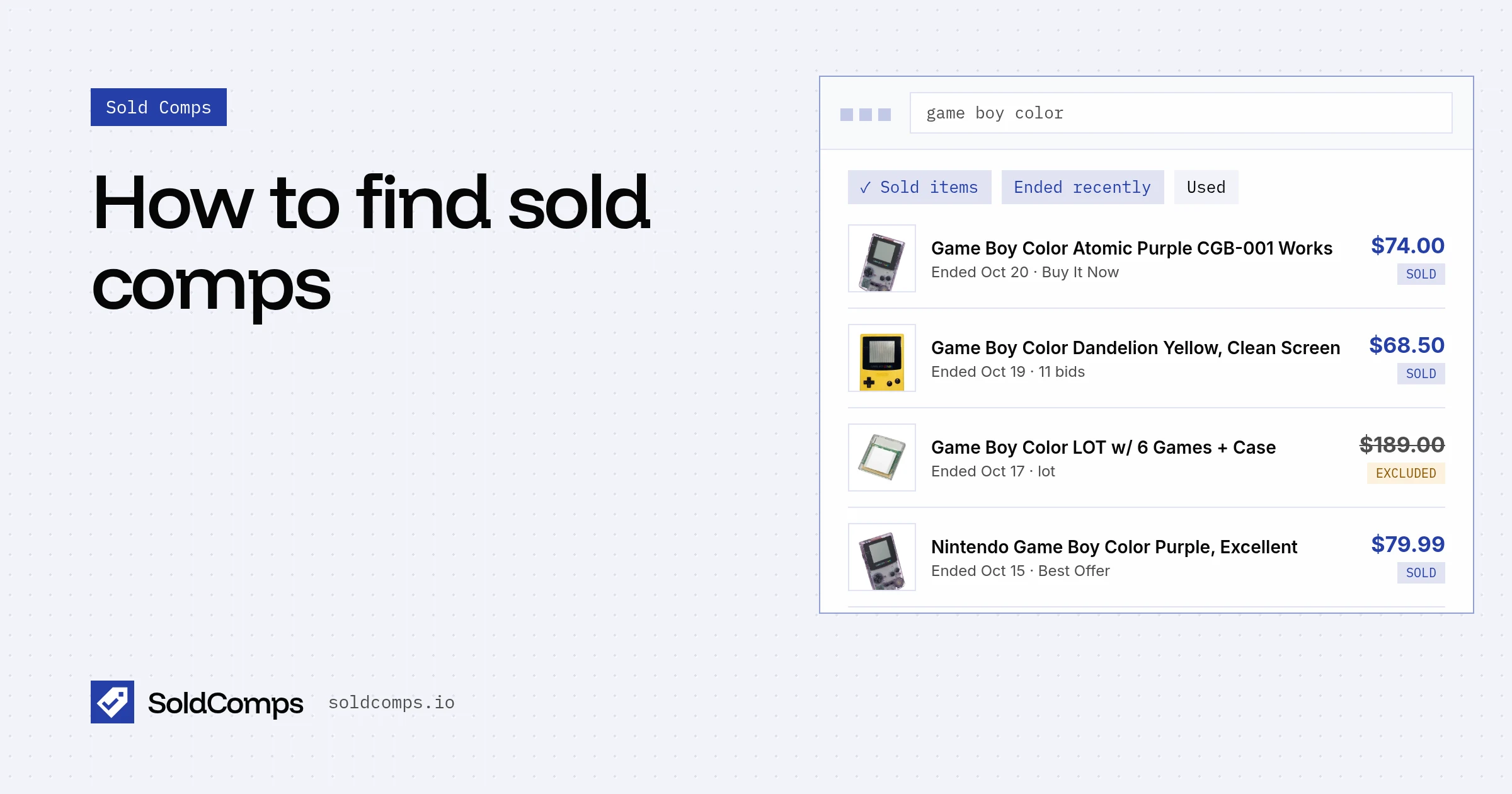
You're holding an item and you need one number: what it actually sells for. That number comes from sold comps, recent completed sales of the same item. Asking prices don't count; many of those never sell.
There are four practical ways to find them, depending on whether you're checking one item or a whole bin. Then there's the part most people skip: making sure the comps are real.
1. On eBay, with the Sold items filter
eBay is where most resale pricing starts, because it has the deepest sold history for most categories.
- Sign in first. Since 2026 eBay only shows sold listings to signed-in users. Signed out, the filter just isn't there.
- Desktop: search the item, then tick Sold items in the left sidebar. Sort by "Ended recently."
- App: search, tap Filter, turn on Sold items. If it's missing, the website has been more reliable.
- History: about 90 days. Older sales aren't in the search.
Sold prices show in green. Unsold completed listings show in black or struck through, so don't mix them in. Full walkthrough: how to see sold listings on eBay.
The catch: eBay shows you a list, not a price. You still have to scroll, spot the lots, and do the math yourself.
2. In a free sold comps lookup (no sign-in)
Our homepage is a free sold comps lookup. Type the item, pick the condition, and you get recent eBay sales plus:
- the median sold price,
- the middle range (where the middle half of sales landed),
- lots, for-parts and box-only listings flagged and left out of the stats.
No eBay account needed, 5 free lookups a day. It's the fastest way to go from "what is this worth?" to a number when you're standing in a thrift store aisle. Here's the 30-second workflow for checking sold comps on your phone.
3. On other marketplaces
Some other marketplaces also show sold or completed items, and they're worth a look when your item mainly trades there (a niche platform for a specific category, for example). Use them the same way: exact item, same condition, recent sales only.
That said, for most categories eBay has the most sales and the longest searchable history, so it's usually the baseline. If another marketplace consistently sells higher or lower, that's useful to know, but price against the market with the most data first.
4. For many items at once: Google Sheets or the API
Checking 300 items from an estate one at a time takes all day. Two options:
- Google Sheets. Put item names in column A and pull a median for each with a formula. Setup: eBay sold listings in Google Sheets.
- The API. One request is one search and returns up to 200 sold listings, with stats already computed:
curl "https://www.soldcomps.io/v1/sold?q=nintendo+switch+oled&condition=used" \
  -H "Authorization: Bearer $SOLDCOMPS_KEY"
# → { "count": 147, "excluded": 42, "stats": { "median": 175.00, "p25": 150.00, "p75": 197.00, ... } }
The free plan covers 100 requests a month; see pricing for more. Building a tool for resellers? Start with the API docs.
How to make sure the comps are real
Finding sales is easy. Finding the right sales is the job. Before you trust a number:
- Put the exact model or edition in the query. "Switch OLED," not "Switch." "Pyrex 403," not "Pyrex bowl."
- Match condition. New, used and for-parts are three different markets.
- Drop lots, for-parts and box-only sales. A console with three games isn't a comp for a console. An empty box isn't either.
- Use the median, not the average. One $900 bundle drags an average up; the median ignores it. Why the median wins.
- Check sale dates. A price from 11 weeks ago may not hold today, especially for electronics and cards.
- Count the clean sales. At least 10. Fewer than 5 is a guess.
Worked example: a used Nintendo Switch OLED
Here's what a raw search actually contains. Data: eBay US sold listings, last 90 days, pulled Oct 26, 2026. Prices move, so treat these as a snapshot.
| Sales | |
|---|---|
| Sold listings matching "nintendo switch oled," used | 189 |
| Excluded (lots, for-parts, box-only and similar) | 42 |
| Clean comps left | 147 |
More than one in five matched sales wasn't a comp for a single working console. Sold prices ran from $28 to $900, a range that tells you nothing on its own. Averaging a raw search like that mixes empty boxes, broken units and bundles in with the consoles you're actually pricing.
After cleanup:
| Stat | Price |
|---|---|
| Median | about $175 |
| Middle half of sales | $150 to $197 |
| Auction median (21 sales) | $155 |
| Buy It Now median (126 sales) | $179 |
So a used Switch OLED is roughly a $175 item, most sell between $150 and $197, and auctions close a bit lower than Buy It Now. If you're buying to resell, the low end of that range is your ceiling. If you're listing, the median is your starting point. Auction vs Buy It Now prices, explained.
Eyeballing those 189 listings on eBay, you'd have to spot all 42 junk sales by hand. That's the difference between a list of sales and a price.
Which method should you use?
- One item, you have an eBay account: the Sold items filter.
- One item, fast, no sign-in, want the math done: the sold comps lookup on our homepage.
- Dozens or hundreds of items: Google Sheets or the API.
New to the idea? Start with what sold comps are and why they beat asking prices. Want the eBay-only, 60-second routine? See how to pull eBay comps fast.
Frequently asked questions
Where can I find sold comps for free?
On eBay itself, by signing in and ticking the Sold items filter, or in our free sold comps lookup on the homepage, which needs no eBay sign-in and gives you 5 lookups a day with the median and middle range already worked out.
Why can't I see sold listings on eBay anymore?
Since 2026 eBay only shows sold results to signed-in users. Sign in, search, then tick Sold items under the filters. If the filter is missing in the app, try the website.
How far back do sold comps go?
eBay's sold search covers about the last 90 days. For most items that's enough, and for fast-moving categories like electronics, cards and sneakers, the most recent few weeks matter most.
How many sold comps do I need to trust a price?
At least 10 clean sales of the same item in the same condition. With fewer than 5, treat the median as a rough guess and price conservatively.