Sold Comps for Resellers: Set a Max Buy Price Before You Pay for Anything
Most resellers learn to check sold listings before they list something. The bigger money is in checking them before you buy something. A pricing mistake after you buy costs you a few dollars. A buying mistake costs you the whole purchase price, plus the shelf space, plus the time.
So the most useful thing sold comps can give a reseller is one number: the most you should pay. Here's how to work it out, with real eBay numbers.
The max buy price formula
max buy price = median sold price
              − marketplace fees
              − shipping (if you offer free shipping)
              − the profit you want
On eBay, the final value fee in most categories is 13.6% of the total sale plus $0.40 per order (for orders over $10). Some categories differ, so check eBay's fee page for yours. If your listing price includes shipping, you pay that fee on the shipping too, which is why the formula takes fees off the full median.
Then subtract the real postage you'll pay, and the profit you need for the flip to be worth listing.
Worked examples (real sold comps)
eBay US sold listings, last 90 days, pulled Oct 30, 2026. "Clean" means lots, for-parts sales, empty boxes and outliers removed before taking the median. Shipping and profit targets are examples. Use your own.
| Item | Clean sales | Median sold | After eBay fees | Shipping | Profit wanted | Max buy |
|---|---|---|---|---|---|---|
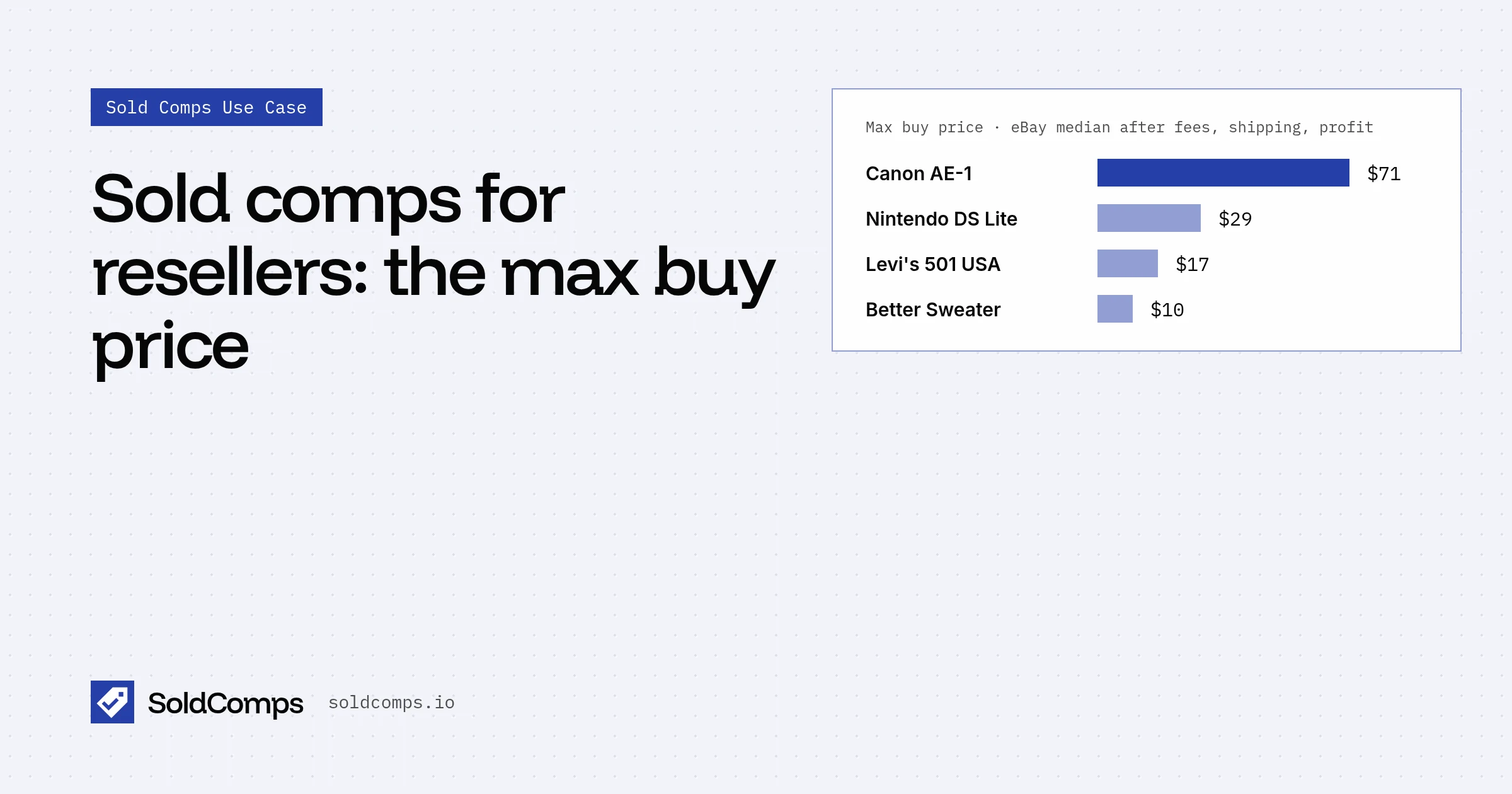
| Canon AE-1 film camera | 106 | $137.48 | $118.38 | $12 | $35 | $71 |
| Nintendo DS Lite | 81 | $59.99 | $51.43 | $7 | $15 | $29 |
| Levi's 501, vintage, made in USA | 71 | $48.02 | $41.09 | $9 | $15 | $17 |
| Patagonia Better Sweater | 118 | $35.28 | $30.08 | $8 | $12 | $10 |
| Le Creuset 5.5 qt Dutch oven | 120 | $200.00 | $172.40 | $25 | $50 | $97 |
Prices move. Treat these as a snapshot of the method, not a price list.
A few things jump out:
- A $35 sweater is a $10 buy. After fees, shipping and a modest profit, a third of the sold price is gone. That's normal for low-ticket clothing, and it's why many resellers skip anything that can't clear a minimum dollar profit.
- Heavy items eat the margin. The Le Creuset sells for $200, but a 5.5 qt pot weighs over 11 pounds before you pack it, so shipping is real money. Price shipping before you decide it's a great find.
- Cameras and electronics carry more room. The AE-1's higher median leaves space for a meaningful profit even after testing and shipping.
Don't stop at the median: read the range and the count
The median is the headline. Two other numbers tell you how much to trust it.
The middle range (25th to 75th percentile). This is where the middle half of sales landed.
- DS Lite: $52 to $71. Tight. Buyers agree on the price, so the median is safe to use.
- Levi's 501 USA: $34.99 to $69.22. Wide. Size, fit, fading and the exact era move the price a lot. For your pair, pull comps with the waist, length and details in the search before trusting $48.
- Le Creuset 5.5 qt: $143 to $280. Wide, because color, generation and chips matter. Check condition carefully and lean toward the low end.
When the range is wide, use the 25th percentile instead of the median in the formula. That gives a max buy that still works if yours turns out to be an ordinary example.
The count. Ten or more clean sales is a price. Three to nine is a rough guide. Under three is a guess. There's more on this in how many sold comps you need.
Speed matters as much as price
Two items with the same median aren't the same buy if one sells in a week and the other sits for six months. Money tied up in slow inventory can't buy the next deal.
You can get a feel for speed from the sold comps themselves. Look at how many sales there were and over how many days:
- Patagonia Better Sweater: 190 sales in the 6 days from Oct 25 to Oct 30, 2026. That's a fast market. If you price at the median, it will move.
- Levi's 501 USA: 131 sales over about 70 days. Steady, but slower, and spread across many sizes.
For a sharper read, compare sold listings to active ones. That's the eBay sell-through rate, and it tells you how crowded the market is. On a slow item, raise the profit you want, which lowers your max buy.
A sourcing routine that works at the shelf
- Search the exact item. Brand, model, size, color or edition. "Nintendo DS Lite" is fine. "Vintage camera" isn't.
- Look at clean sales only. Drop lots, for-parts listings and empty boxes. A free sold comps lookup does this automatically.
- Note the median, the range and the count. Wide range or few sales? Use the low end.
- Work out your max buy. Median after fees, minus shipping, minus profit. Round down.
- Compare to the tag. Under it, buy. Over it, negotiate or walk.
The whole thing takes about 30 seconds per item once it's a habit. On your phone, the sold comps app guide covers what to use in the aisle.
The mistakes that cost resellers money
- Anchoring on the highest sale. The $280 Le Creuset was probably a rare color in perfect shape. Yours probably isn't.
- Using asking prices. Active listings show what sellers hope for. Sold comps show what buyers paid. See sold comps vs active listings.
- Forgetting the item's real condition. Untested electronics, missing pieces and stains belong in the for-parts or low-end bucket, not at the median.
- Ignoring Best Offer. When a sale ended in an accepted offer, the price shown may be the original asking price, not what the buyer paid. How to read Best Offer sold prices explains how to spot it.
Pricing a whole haul
At a bulk buy, an estate sale or a storage unit, you can't comp 200 items one at a time on your phone. Put the item names in a spreadsheet and pull the median, range and count for each row. The Google Sheets formula does it in one column, and automating sold comps shows the same thing in a short script.
Either way, the decision is the same one you make at the shelf: what it sold for, minus what it costs you to sell it, minus what you need to earn. That's how resellers actually use sold comps.
Frequently asked questions
How do resellers use sold comps?
Mainly to decide what to pay. Before buying, they look up what the exact item actually sold for on eBay recently, take the median, subtract fees, shipping and the profit they want, and only buy if the price tag is under that number.
What is a max buy price?
The most you can pay for an item and still make the profit you want. Median sold price, minus marketplace fees, minus shipping, minus your target profit. Work it out before you get to the register, not after.
How much profit should I leave on a flip?
It depends on your time and how fast the item sells. Many resellers want a minimum dollar profit per item (so they don't list $3 flips) and a bigger cushion on slow or fragile items. Fast sellers with a tight price range can run on thinner margins.
Should I use the highest sold price to decide?
No. The top sales are usually the best-condition, best-photographed examples. Use the median, and if you're unsure about condition or completeness, use the 25th percentile (the low end of the middle range).
Sources
- eBay: Selling fees (final value fee and per-order fee) (accessed Oct 30, 2026)
SoldComps sells an eBay sold-listings API, so we have a commercial interest in this topic. We link primary sources so you can check our work. Spotted something out of date? Email hello@soldcomps.io.